Unreviewable Fluency
The better the work looks, the less it tells you. And you're the one signing it.

A senior partner of a mid-market private equity firm said this to me recently, about the AI rollout at his firm:
“The tools are great! The team might not even need me to weigh in any more haha.”
Everyone did what you’re supposed to do with a line like that. We laughed. The laugh is the transaction the joke exists to complete: he says a true thing in costume, the room agrees not to notice it’s true, and everyone gets back to work.
I’ve stopped laughing at this one, because I keep hearing it. Different firms, different words, same construction: a comment about the tools that isn’t about the tools, dressed as amusement, delivered with the timing of someone testing the ice.
Here is a Tuesday I keep sitting in.
The work from the team arrives on the leader’s desk. A memo, an analysis, a deck. Thirty pages where there used to be ten, finished-looking in a way that used to take a week longer, and it’s waiting on one signature. I watch that person read. Somewhere around page six, I see them notice what they’re not doing: they’re not finding anything. Not because the page is right, but because the looking has nothing to grab. The prose is clean. The structure is right. The numbers agree with each other everywhere they touch.
You already know the decision the leader now faces. Redo it yourself, and lose an evening you don’t have. Send it back, and say — what, exactly? Make it different? There’s no real feedback to give, because nothing is wrong that you can point to. Or the third option: approve the work and send it through. Nothing pops as wrong, after all, and the deadline is real.
Not lazily; you gave it two hours instead of the usual one. You’d swear to the parts you checked. But the old instrument stayed silent the whole read, the one that used to reliably tell good work from good-looking work.
I went looking for a name for that Tuesday and came back empty. Everyone seems to feel it, but nobody is cleanly naming it. So I am giving it a name: unreviewable fluency.
Unreviewable fluency is what happens when the finish of the work stops telling you anything about the thinking underneath it. The work hasn’t merely gotten harder to check; it arrives having quietly placed itself beyond the reach of checking.
Here’s what you were actually reading, all those years you could find the weak spots: not the work, but the evidence about the work. The paragraph that ran long because the thinking got hard there. The hedge that crept in where the author wasn’t sure. The section that went thin when time ran out. The join where two drafts met and didn’t quite agree. Making used to leave a residue, and a career of reading that residue is a large part of what your judgment is.
You were never skimming for errors. You were reading effort, hesitation, confidence, and pressing where they told you to press.
Fluent work is born smooth. No seams, no hesitation, no awkward numbers that stand out, no section that doubts itself. Uniform confidence on every page, the strong claims wearing the same finish as the weak ones. The conclusion agrees with the setup, and the whole thing agrees with you.
Nobody hid the signals from you. The signals are simply flattened by the fluency. Polish stopped being evidence.
Checking for contradictions, hesitation, and unfinishedness was your test. The trouble is that fluent work always passes it. Internal consistency isn’t news about the world. It’s what the machine produces by default, running as designed. And agreement with you isn’t corroboration. It’s your own framing coming home polished and dressed as findings. Agreement has moved into the chair where evidence used to sit, and it feels enough like evidence that the substitution goes unnoticed.
The finished-looking thing does more than pass your checks, though. It starts to run the room. I’ve written before about the strange gravity a polished deck exerts on a team; a fluent draft has that gravity at birth. Watch the questions change once it lands. Nobody asks whether the analysis should have been built differently. Nobody questions how the problem was framed. The deck’s existence has already answered that. “Is this right?” relaxes into “Any comments?” The meeting becomes a page-turn. Edits happen inside its frame, version five inherits the skeleton of version one, and the room spends its intelligence improving the words and internal coherence instead of the understanding. And the words do improve beautifully.
Now take the stairs down one floor of the building, because the joke from the opening already lives there. The associate meets the model’s draft the way the partner met theirs: long, clean, agreeing with itself and agreeing with the associate. Ask the model to take another look, and it doesn’t return a marked-up second opinion; it returns another seamless first draft.
So the associate faces a similar choice. Rebuild the thing by hand, and blow the deadline the tools were bought to beat. Send it through as finished. Or say the doubt out loud — I couldn’t verify the middle section — and hope it lands as diligence rather than incompetence, coming from the desk with the least standing in the building.
In the version of the joke that gets told downstairs: “Sure, that analysis is my work. Except the mistakes. Those aren’t mine haha.”
That’s not deflection. It’s a flag: an accurate mark on the work. The partner has no idea his joke has a downstairs version. The draft nobody could quite read or verify becomes the memo nobody can quite read or verify, and the memo goes out of the building. Every desk is now downstream of the desk that produced the draft.
Last October, Deloitte’s Australian arm refunded part of an A$440,000 fee to a government client after an academic, an outside reader with time and stakes, checked a polished report’s references and found that some didn’t exist, and that a quote attributed to a Federal Court judgment had been invented. The corrected version disclosed the AI toolchain. I don’t think there is anything unusually neglectful about Deloitte’s practices — I used to work there and I can vouch for the good intent and diligence of the people I worked with. The only unusual thing that happened is that somebody outside the building read something closely.
But in one profession, where the work is built to land in front of a paid adversary and a judge, close reading is almost guaranteed.
Damien Charlotin, a legal researcher in Paris, keeps a public tally of court decisions that caught fabricated citations: cases, quotes, precedents that read perfectly and don’t exist. When the tally began, it grew by a trickle every week. By early July, 2026, it stood at over 1,700 cases, each one a Tuesday where the work fit, went through, and finally met a reader equipped to check it.
Which is the thing to understand if your industry has produced no headlines. Private deals, private clients, investment decisions. Work that never meets a stranger: no adversary, no judge, no database anyone could keep. The check still comes. It just arrives years later, denominated in the fund’s returns, the investment’s ROI, or the client’s stock price, unattributable to any particular Tuesday. Your industry doesn’t have fewer Tuesdays. It has fewer public readers.
The read the partner used to have isn’t coming back on its own. Nobody is going to type slower on purpose; the tools aren’t going to produce fewer analyses, fewer drafts, and fewer fluent outputs. The residue you used to read was never designed anyway; it was exhaust.
But what was never designed can be replaced by something that is. If the making of the memo no longer leaks onto the page, then the making must be declared on the page, as the page is made, by the maker of the page. And the maker isn’t just the associate anymore — it’s the associate’s AI too.
Run the Tuesday once more with that single change. The thirty pages arrive marked, by the maker, while the making was happening.
What’s the organizing seed? What are the load-bearing assumptions and derived results this conclusion depends on? What nearby alternatives were considered and discarded? What provided the selection pressure to distinguish good from bad? What is stress-tested and what should you stress further? What fundamentally changed from the previous version? What broke that needed fixing? What’s still live and worth pushing on?
Page six suddenly has something to grab. Not because the work got rougher, but because the judgment underneath it finally shows. Your hour changes shape: no more hunting the smoothness for a snag; you press where the work tells you to press, and take your own look where your look is the point. That isn’t proofreading. That’s the job coming back, the instrument finally reclaiming a surface to examine.
It’s an installation, not an invention, because your people are already halfway doing it. The flag the associate filed inside the joke — the mistakes aren’t mine — is a true mark about the work with nowhere to live. The discipline doesn’t ask anyone to become someone new. It gives that honesty a channel with standing, and it recruits the AI to mark the roughness of the thinking alongside the smoothness of the output. What gets smuggled out in a haha becomes something written on the work in daylight, where the marked unknown reads as professionalism instead of incompetence.
Downstairs, that’s the restoration: the hand that sends work up knows exactly what it’s vouching for, and can finally say so without it sounding like a confession.
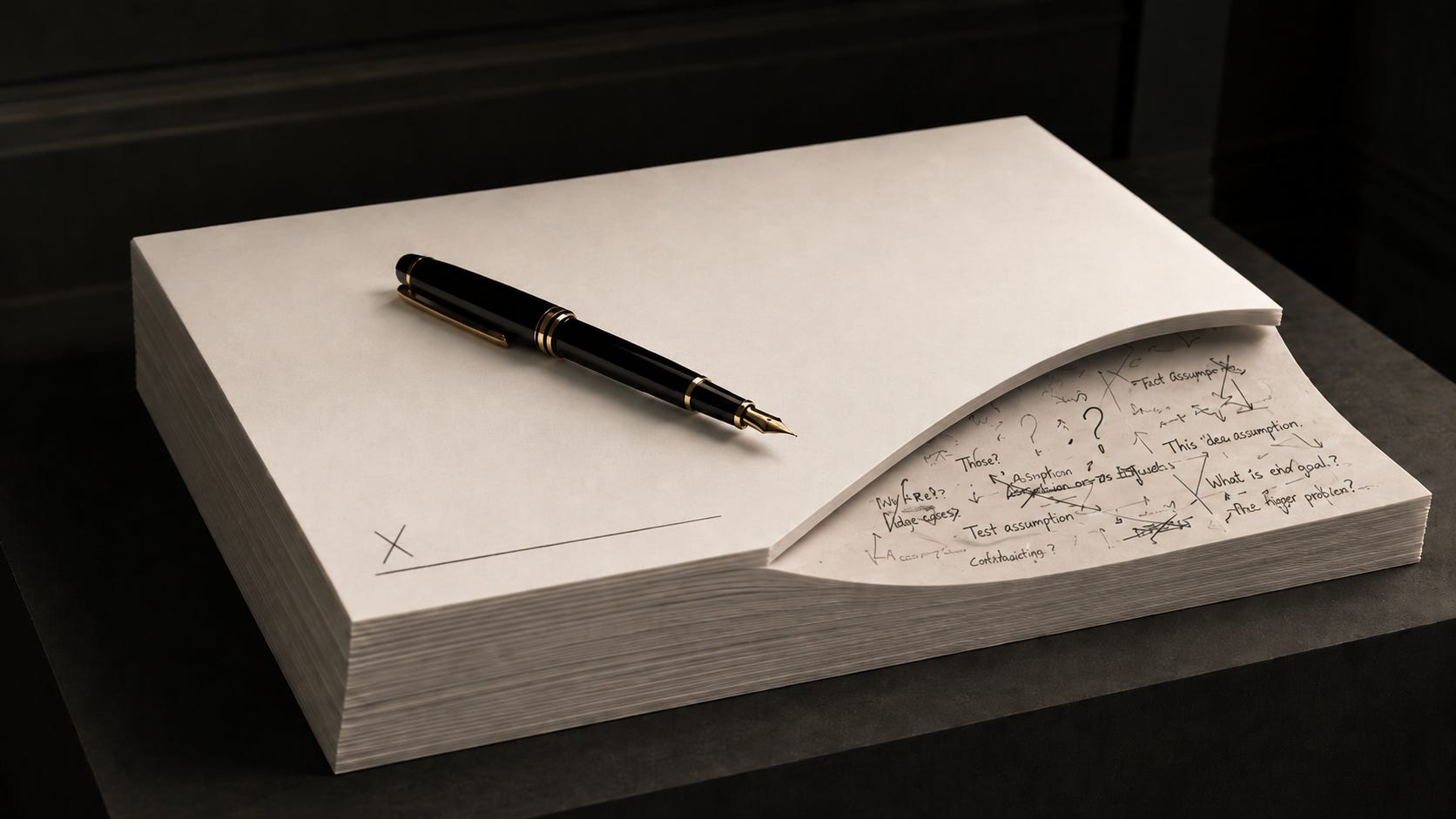
What changes upstairs is quieter. The pen gets lighter, because you know what you’re signing again, and could say out loud why. The warrant rides in the work now, not in the confidence of whoever hands it over.
“The team might not even need me to weigh in any more haha.”
The partner wasn’t asking about the tools. He was asking whether the part of the job that was his still existed. And one desk down, his associate had already told the other version of the joke. In the office next door, another partner, another version. In the building across the street, yet another. The joke is on everyone, which is the moment it stops being on anyone.
The fix is a new discipline for making and reviewing AI-native work, and on the far side of it, the plainest thing a working life can offer: work you can stand behind.
Bud Bhattacharyya is the Founder and Principal of re:compound. He works with senior leaders to install the operating discipline for AI-native professional work — how it is produced, how it is reviewed and relied on, and how the judgment spent on it compounds instead of leaking.
Great post! I think there's a weird world emerging where we start looking for obvious human errors as an indication that there was a human who put in the time and effort to generate the ideas.